We’ve all been there. You’re sat in a classroom, watching a teacher scribble endlessly on a whiteboard while their voice drifts into a monotone “chalk and talk.” You might be nodding, you might even be taking notes, but are you actually learning?

At Bonanza Creative, our mission has always been to fight that feeling of school-day disengagement. We know that the conventional “chalk and talk” method often misses the spark required to ignite a child’s potential. But you don’t just have to take our word for it. Decades of educational neuroscience and classroom studies prove that drama and activity-based learning aren’t just “fun extras”, they are significantly more effective at embedding knowledge than traditional passive instruction.
Here is the deep dive into the science of why “doing” beats “listening” every single time.
1. The “Illusion of Learning”: Why Lectures Deceive Us
One of the most fascinating pieces of recent research comes from Harvard University (Deslauriers et al., 2019). Researchers compared students in traditional lecture-based classrooms with those in “active learning” environments.
The results were startling: students in the “chalk and talk” group actually felt like they were learning more because the experience was “smooth” and required less effort. However, when tested, the students in the active learning group scored significantly higher. The study concluded that the “struggle” of active participation, moving, deciding, and acting, is exactly what creates deep, long-term retention.
2. Embodied Cognition: Moving the Body to Grow the Mind
Why does drama work so well for subjects like Science or History? It comes down to a theory called Embodied Cognition (Glenberg, 2010). This research suggests that our brains aren’t just “computers” in a jar; they are deeply connected to our physical movements.
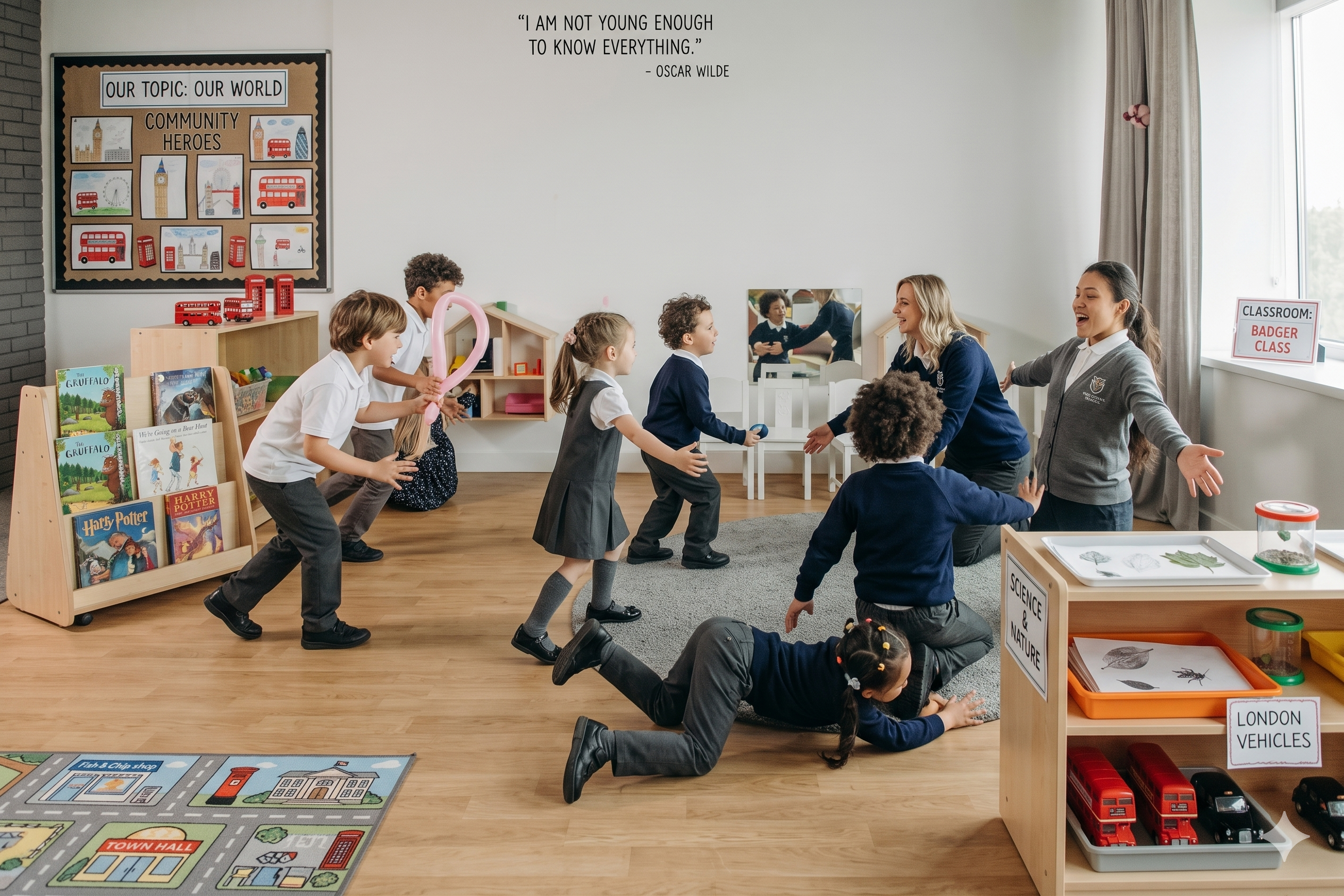
When a child “acts out” the movement of a blood cell or role-plays a historical figure, they aren’t just memorising facts; they are creating a physical and emotional “anchor” for that information. A study by Lee, Hwang & Chen (2020) found that multimodal learning (using multiple senses like sight, sound, and movement) can boost memory retention by as much as 50% compared to unimodal (reading or listening) approaches.
3. The “Three-Month Advantage”
The Education Endowment Foundation (EEF), one of the UK’s leading authorities on evidence-based teaching, has conducted extensive reviews on “Arts Participation.” Their findings show that integrating drama and creative activities into the curriculum can lead to an average of three months’ additional progress in core subjects like literacy and mathematics.
For children who struggle with traditional writing, drama acts as a “pre-writing” tool. By “living” the story through drama first, children develop a richer vocabulary and a deeper understanding of narrative structure before they even pick up a pen.
4. Lowering the “Affective Filter”
Traditional classrooms can be high-pressure environments where the fear of being “wrong” stops children from trying. In linguistics, this is known as the Affective Filter Hypothesis (Krashen, 1982).
Drama creates what researchers call a “protective cloak.” When a child is in character, they feel safer taking risks. This lowers their anxiety (or “filter”), allowing information to reach the parts of the brain responsible for long-term memory. Studies in the Journal for Learning through the Arts show that this is particularly effective for children who are otherwise disengaged or lack confidence.
5. Beyond the Test Scores: The “Creativity Premium”
While the academic gains are clear, the benefits of activity-based learning last a lifetime. A longitudinal study from the University of Warwick (“The Creativity Premium”) found that children who developed strong creative thinking skills through arts-based learning were more likely to secure higher-paying jobs and showed greater resilience in their adult careers.
The Bonanza Bottom Line
The research is clear: “Chalk and talk” might be the old standard, but activity-based learning is the gold standard.
At Bonanza Creative, we don’t just want children to remember a lesson for a Friday test; we want that knowledge to become a part of who they are. By using drama, movement, and creativity, we ensure the “spark” stays lit long after the school bell rings.